
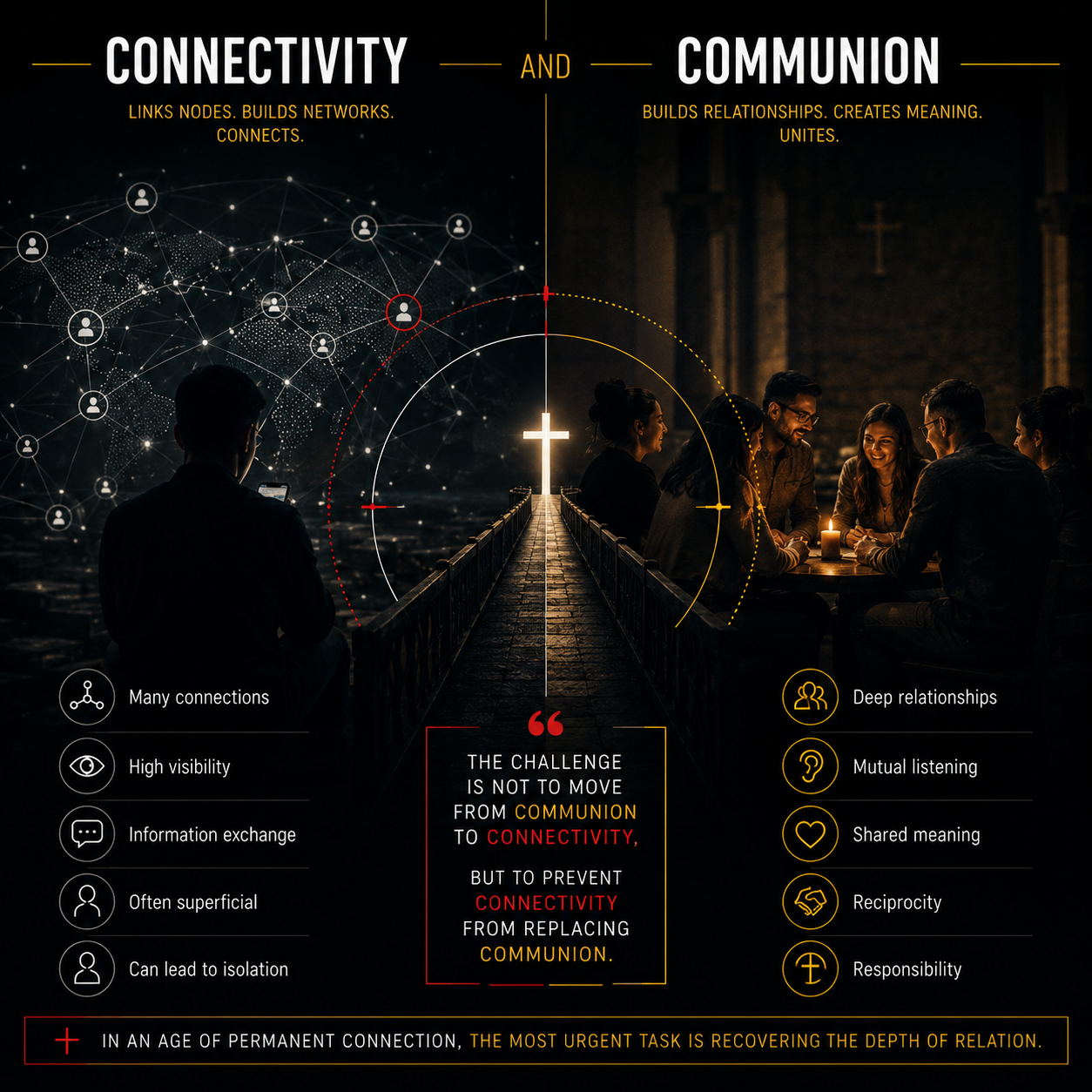
In contemporary digital culture, connectivity is often mistaken for communion.
The two are not the same.
Connectivity links nodes, profiles, and networks.
Communion concerns relationships, meaning, and shared presence.
One can be constantly connected and still remain profoundly isolated.
This distinction matters for how we understand communication today, especially in ecclesial contexts.
Digital platforms multiply possibilities for interaction, but interaction alone does not generate encounter.
Communication becomes communion only when it involves:
- reciprocity
- listening
- recognition
- responsibility
Without these, communication risks becoming exchange without relationship.
For the Church, this distinction is decisive.
An ecclesial presence online cannot be measured only by reach, followers, or activity.
Its deeper criterion is whether communication fosters communion rather than merely connectivity.
This does not mean rejecting digital networks.
It means asking how networks can become spaces of encounter.
The challenge is not to move from communion to connectivity,
but to prevent connectivity from replacing communion.
In an age of permanent connection, perhaps the most urgent communicative task is recovering the depth of relation.