Synodality is not only an ecclesial procedure. It is a communicative practice of repair, especially in a wounded Church that must learn again how to listen, speak, discern, and rebuild trust.
Synodality is often described as walking together.
The image is useful, but it can become too peaceful if we forget the concrete reality of the Church today. The People of God do not walk together as a perfectly harmonious group already moving at the same pace, in the same direction, with the same wounds, hopes, and expectations.
Many walk with trust. Others walk with fatigue. Some walk at the margins. Some no longer know whether they can walk with the Church at all.
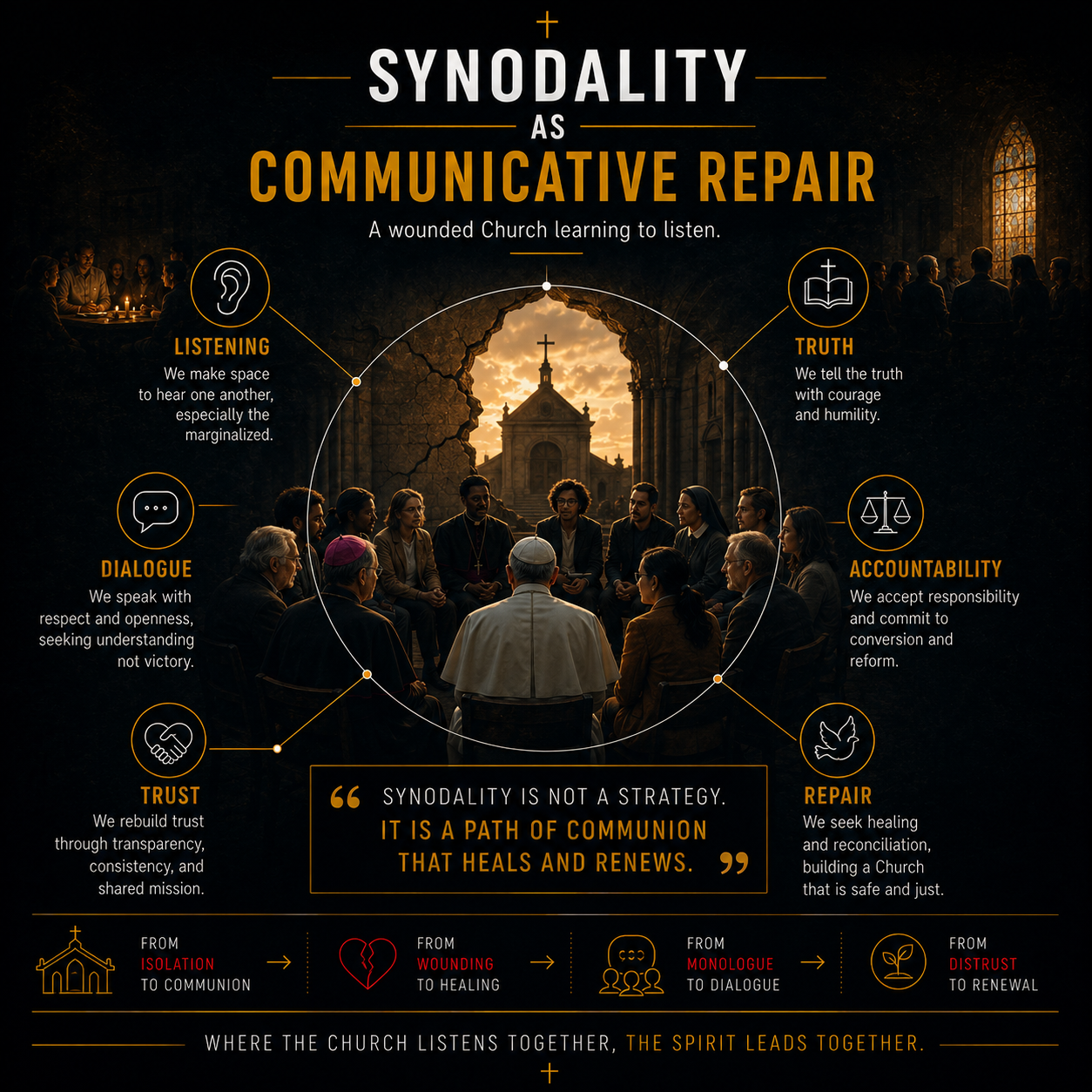
For this reason, synodality cannot be reduced to ecclesial consultation, pastoral planning, or institutional procedure. At its deepest level, synodality is a communicative practice of repair. It concerns how a wounded Church learns to speak truthfully, listen courageously, and discern together without hiding conflict behind polite language.
The crisis of trust in ecclesial life is not only a moral or institutional crisis. It is also a communicative crisis. Many people do not feel unheard in an abstract way. They feel unheard because concrete experiences of pain, exclusion, disappointment, or scandal have not been received adequately.
When communication fails, wounds deepen. When institutions speak too quickly, defensively, or vaguely, they may preserve control but lose credibility. When people are invited to participate but their words do not matter, dialogue becomes performance. When listening is announced but not practiced, synodality becomes rhetoric.
This is why the communicative quality of synodality matters.
A synodal Church must not only create meetings. It must create trustworthy spaces. It must not only collect opinions. It must allow difficult truths to be spoken. It must not only invite participation. It must show that participation can shape discernment.
This requires more than technique. It requires conversion in the way ecclesial authority communicates.
Authority in the Church cannot be credible if it communicates only from above, only after decisions are made, or only in moments of crisis. Synodal authority must become more dialogical, more transparent, and more accountable. It must be capable of receiving the voices of the faithful not as public-relations data, but as expressions of the sensus fidei, of lived ecclesial experience, and at times of legitimate lament.
Lament is important. The wounded Church often wants language of hope, mission, and renewal. These are necessary. But hope without lament becomes superficial. Mission without truth becomes fragile. Renewal without memory becomes institutional self-protection.
Synodal communication must therefore make room for lament. Not because lament is the final word, but because it may be the first honest word. A Church that cannot listen to lament cannot discern responsibly. A community that rushes too quickly toward harmony may avoid the very conflicts that need evangelical attention.
This does not mean that synodality should become permanent conflict. It means that communion cannot be built by denying conflict. Ecclesial communion is not the absence of tension. It is the capacity to remain in truthful relation while discerning through tension.
Here, communication becomes a form of leadership.
Synodal leadership is not simply the ability to organize processes. It is the ability to protect the conditions for truthful encounter. It requires patience, courage, humility, and symbolic intelligence. It must know when to speak and when to listen. It must know when to clarify and when to receive. It must resist the temptation to control every outcome before the process has truly begun.
The challenge is especially urgent in relation to those at the margins. Some remain within the Church but feel estranged from its language, structures, or decisions. Others are disaffiliated but still carry fragments of Catholic memory, spirituality, or moral imagination. Others have been wounded directly by ecclesial failure and cannot easily trust institutional invitations.
A synodal Church cannot simply wait for these people to return. It must ask what kind of communication made their distance possible. It must ask what forms of listening, justice, and repair might make trust imaginable again. This is where synodality and restorative communication meet.
Restorative communication does not begin by defending the institution. It begins by acknowledging harm, listening to experience, naming responsibility, and seeking ways toward repair. It does not replace doctrine, governance, or pastoral planning. But it reminds the Church that credibility is not restored by messaging alone.
Credibility is restored through truth.
Through accountability.
Through listening that has consequences.
Through dialogue that does not fear reality.
If synodality is to become more than a pastoral slogan, it must form communities capable of this kind of communication.
The question is not only: how can the Church speak better? The deeper question is: how can the Church listen in a way that changes how it speaks?
That question belongs at the heart of ecclesial communication.
Because a Church that listens only strategically will speak strategically. But a Church that listens synodally may learn to speak as communion.
And perhaps this is one of the most urgent communicative tasks of the present moment: not simply to improve ecclesial messaging, but to repair the conditions under which the Gospel can be heard with trust.