
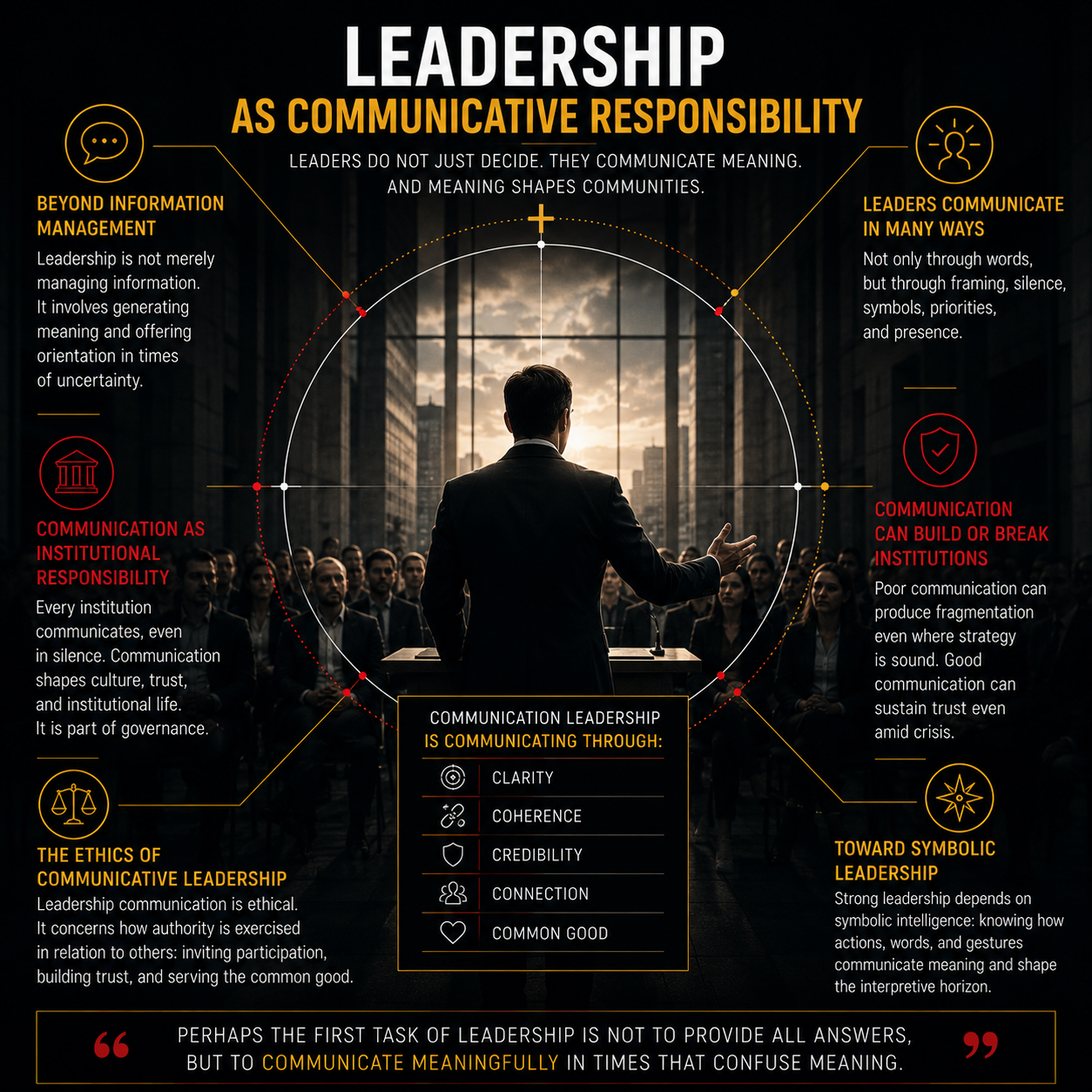
Leadership is often described in terms of authority, decision-making, or vision.
Yet leadership is also, fundamentally, a communicative practice.
Leaders do not communicate only when they speak publicly. They communicate through framing, silence, symbols, priorities, and presence. In this sense, leadership is never external to communication. It is exercised through it.
Beyond Information Management
A common mistake is to reduce leadership communication to message control. But leadership is not merely managing information. It involves generating meaning. Especially in moments of uncertainty, people do not seek only instructions. They seek orientation. And orientation is communicated.
Through clarity.
Through coherence.
Through credibility.
Communication as Institutional Responsibility
Every institution communicates, even in silence. What leaders choose to emphasize, ignore, or delay shapes institutional culture. Communication therefore is not an accessory of leadership. It is part of governance itself. Poor communication can produce fragmentation even where strategy is sound. Good communication can sustain trust even amid crisis.
The Ethics of Communicative Leadership
Leadership communication is not only strategic. It is ethical. It concerns how authority is exercised in relation to others. Whether communication invites participation or reinforces distance. Whether it builds trust or merely preserves control. This is especially relevant wherever leadership claims to serve the common good.
Toward Symbolic Leadership
Strong leadership often depends not only on decisions, but on symbolic intelligence: knowing how actions, words, and gestures communicate meaning.
Leadership, in this sense, is not simply directing institutions. It is helping shape the interpretive horizon within which communities act.
Perhaps the first task of leadership is not to provide all answers,
but to communicate meaningfully in times that confuse meaning.