
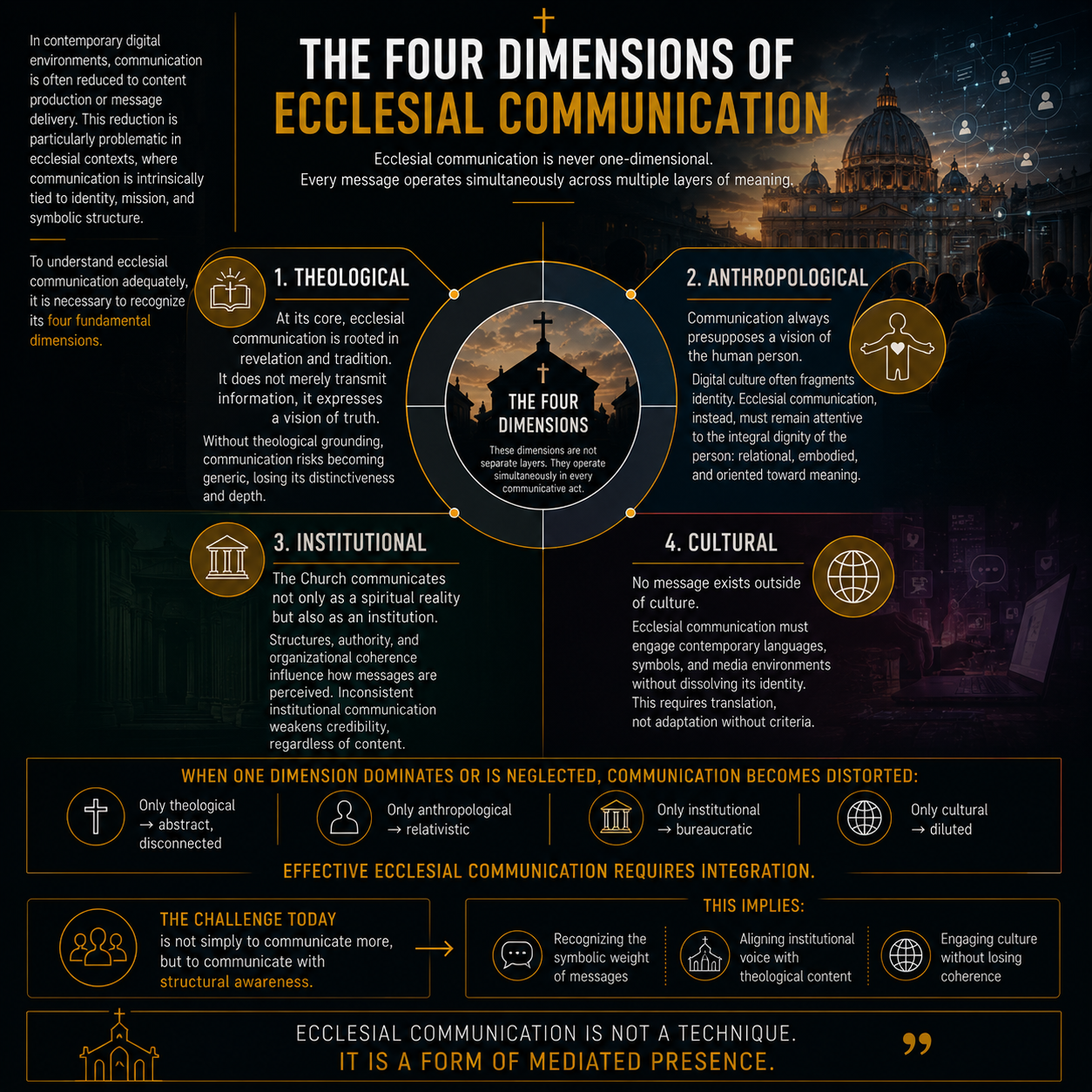
Ecclesial communication is never one-dimensional.
Every message operates simultaneously across multiple layers of meaning.
In contemporary digital environments, communication is often reduced to content production or message delivery. This reduction is particularly problematic in ecclesial contexts, where communication is intrinsically tied to identity, mission, and symbolic structure.
To understand ecclesial communication adequately, it is necessary to recognize its four fundamental dimensions.
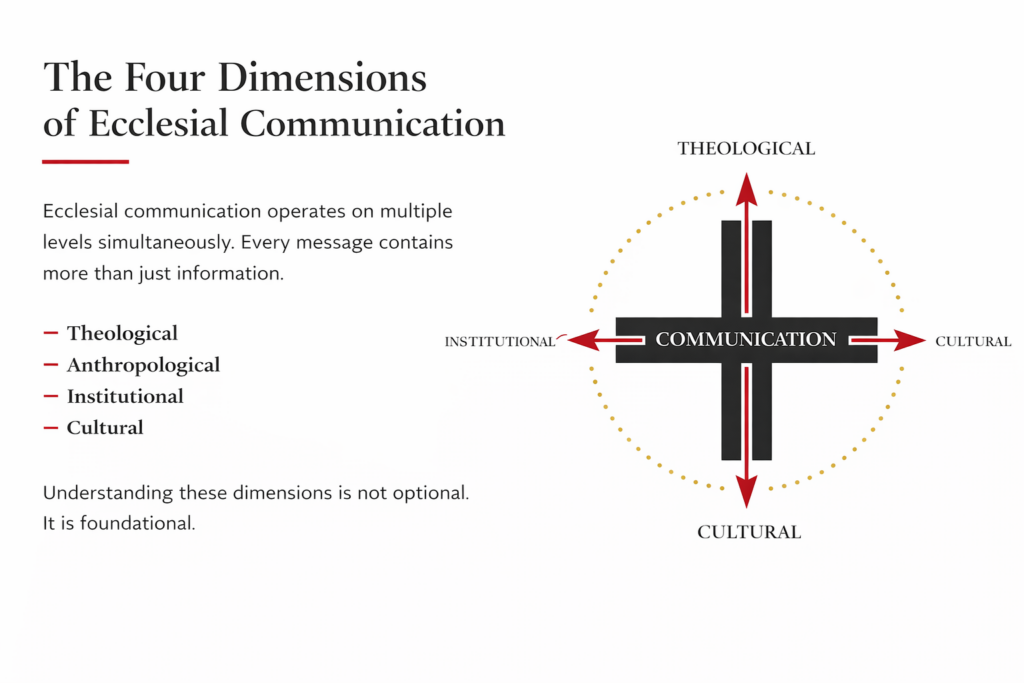
The Four Dimensions
1. Theological
- At its core, ecclesial communication is rooted in revelation and tradition.
- It does not merely transmit information, it expresses a vision of truth.
- Without theological grounding, communication risks becoming generic, losing its distinctiveness and depth.
2. Anthropological
- Communication always presupposes a vision of the human person.
- Digital culture often fragments identity. Ecclesial communication, instead, must remain attentive to the integral dignity of the person: relational, embodied, and oriented toward meaning.
3. Institutional
- The Church communicates not only as a spiritual reality but also as an institution.
- Structures, authority, and organizational coherence influence how messages are perceived. Inconsistent institutional communication weakens credibility, regardless of content.
4. Cultural
- No message exists outside of culture.
- Ecclesial communication must engage contemporary languages, symbols, and media environments without dissolving its identity. This requires translation, not adaptation without criteria.
These dimensions are not separate layers.
They operate simultaneously in every communicative act.
When one dimension dominates or is neglected, communication becomes distorted:
Only theological → abstract, disconnected
Only anthropological → relativistic
Only institutional → bureaucratic
Only cultural → diluted
Effective ecclesial communication requires integration.
The challenge today is not simply to communicate more, but to communicate with structural awareness.
This implies:
– recognizing the symbolic weight of messages
– aligning institutional voice with theological content
– engaging culture without losing coherence
Ecclesial communication is not a technique.
It is a form of mediated presence.