
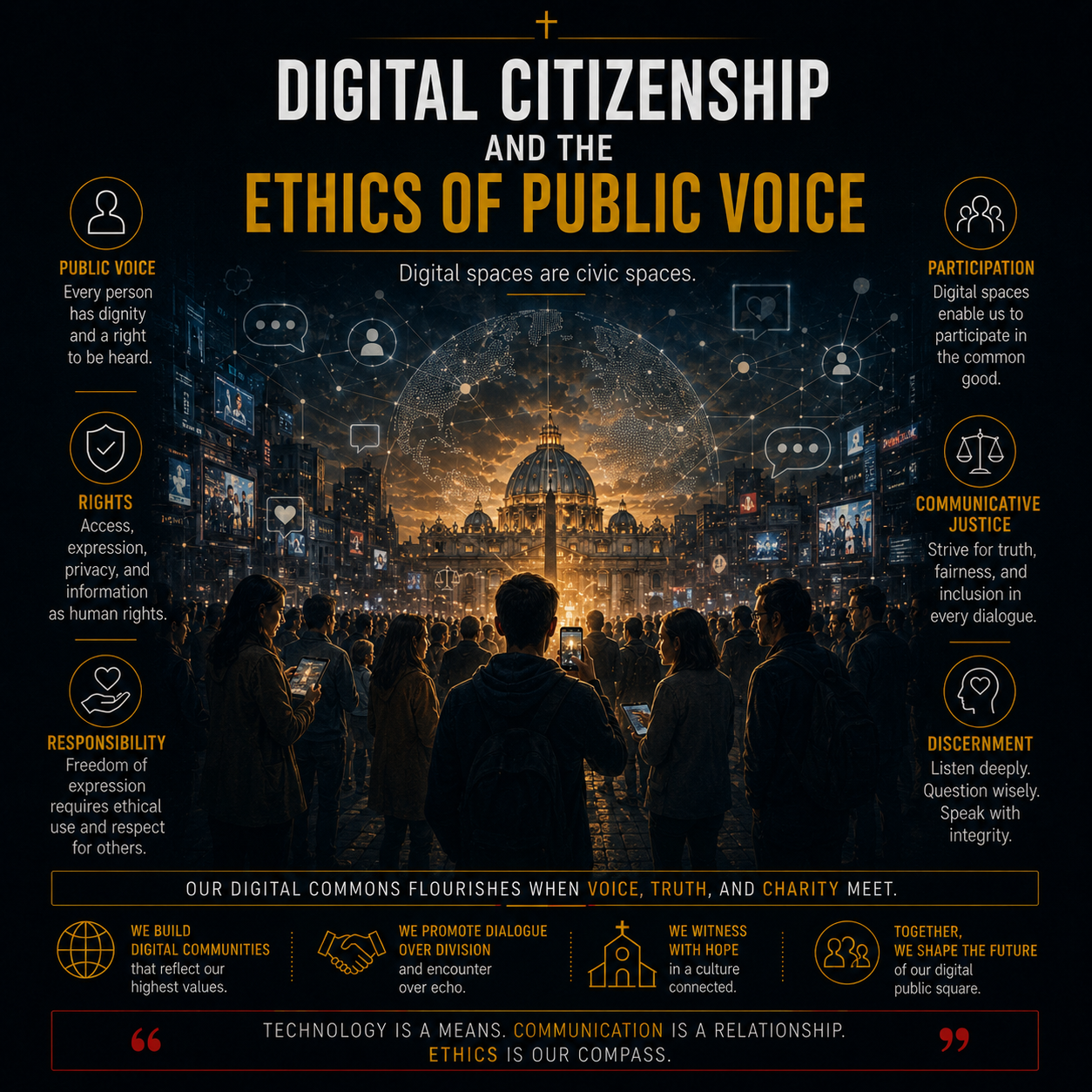
Digital citizenship is not only about access to technology. It concerns how persons and communities make claims, exercise responsibility, and participate in public life through digital environments.
Digital citizenship is often reduced to technical competence.
To be a digital citizen, in this simplified view, means knowing how to use platforms responsibly, protect one’s data, avoid misinformation, and behave correctly online. These things matter. But they do not exhaust the meaning of digital citizenship.
The digital citizen is not simply a competent user. The digital citizen is a political and communicative subject.
Digital environments are now places where people speak, organize, contest, accuse, remember, mourn, mobilize, and make claims. Public life no longer unfolds only in parliaments, streets, newspapers, churches, schools, or civic associations. It also unfolds through platforms, hashtags, livestreams, digital archives, comment sections, encrypted groups, and algorithmic spaces.
This means that digital communication is not merely social. It is civic.
It shapes how people appear before one another. It influences whose suffering becomes visible and whose remains invisible. It affects which claims are amplified, filtered, mocked, blocked, monetized, or forgotten. For this reason, digital citizenship cannot be treated only as a matter of online etiquette. It must be understood as a question of rights, responsibilities, and public voice.
Every act of digital communication takes place within structures that are not neutral. Platforms invite participation, but also organize it. They make some actions easy and others difficult. They encourage visibility, but also track behavior. They promise connection, but also generate data. They open spaces for speech, but also create new forms of exclusion, surveillance, manipulation, and control.
This is the paradox of digital public life. The same environments that allow people to speak can also capture them. The same platforms that make participation possible can also transform participation into data. The same networks that help communities mobilize can also expose them to profiling, intimidation, and manipulation. This does not mean that digital action is useless. It means that digital action is morally and politically complex.
A serious account of digital citizenship must resist two simplistic narratives.
- The first is the utopian narrative: the idea that the Internet naturally produces freedom, participation, democracy, and openness.
- The second is the dystopian narrative: the idea that digital life is only domination, surveillance, manipulation, and loss.
Both narratives are incomplete. Digital culture contains both openings and closures.
It can open spaces for solidarity, testimony, participation, and rights claims. It can also close spaces through tracking, filtering, harassment, polarization, and algorithmic control. The ethical question is not whether digital culture is good or bad in itself. The question is how persons and communities act within it, and how they can reshape its conditions toward justice, truth, and the common good.
This is where Catholic social thought can offer an important contribution.
The tradition of Catholic social reflection insists that human dignity is never isolated from social life. Persons become themselves in relation. Rights are linked to responsibilities. Participation is not a decorative value, but a condition of the common good.
Applied to digital culture, this means that access alone is not enough. A society may give people access to platforms while still failing to protect their dignity. It may invite participation while manipulating attention. It may speak of freedom while turning persons into data profiles. It may celebrate connectivity while weakening the conditions for real public deliberation.
Digital citizenship therefore requires more than digital inclusion. It requires communicative justice.
Communicative justice asks who can speak, who is heard, who is silenced, who is tracked, who is targeted, who is misrepresented, and who benefits from the circulation of digital speech.
It also asks what kind of public life is being formed by our communication practices.
- Are digital spaces helping us become more attentive to one another?
- Are they deepening our capacity for solidarity?
- Are they forming citizens capable of discernment?
- Or are they producing fragmented publics, reactive identities, and exhausted communities?
To be a digital citizen is not simply to have an account, a device, or a voice. It is to inhabit digital spaces with responsibility toward others. This responsibility includes truthfulness, but it also includes restraint. It includes participation, but also discernment. It includes the courage to speak, but also the humility to listen. It includes defending one’s rights, but also recognizing the dignity of those with whom one disagrees.
In this sense, digital citizenship is a communicative vocation. It asks us to understand that what we do online is not detached from the rest of life. There is no completely separate digital world where speech has no consequences. Words, images, likes, shares, and silences all participate in the formation of social reality.
Digital communication forms publics. Publics form imaginations. Imaginations shape institutions. Institutions shape the conditions of human dignity.
The task, then, is not merely to be safer online. The task is to become more responsible communicative subjects. That is the ethical horizon of digital citizenship.