
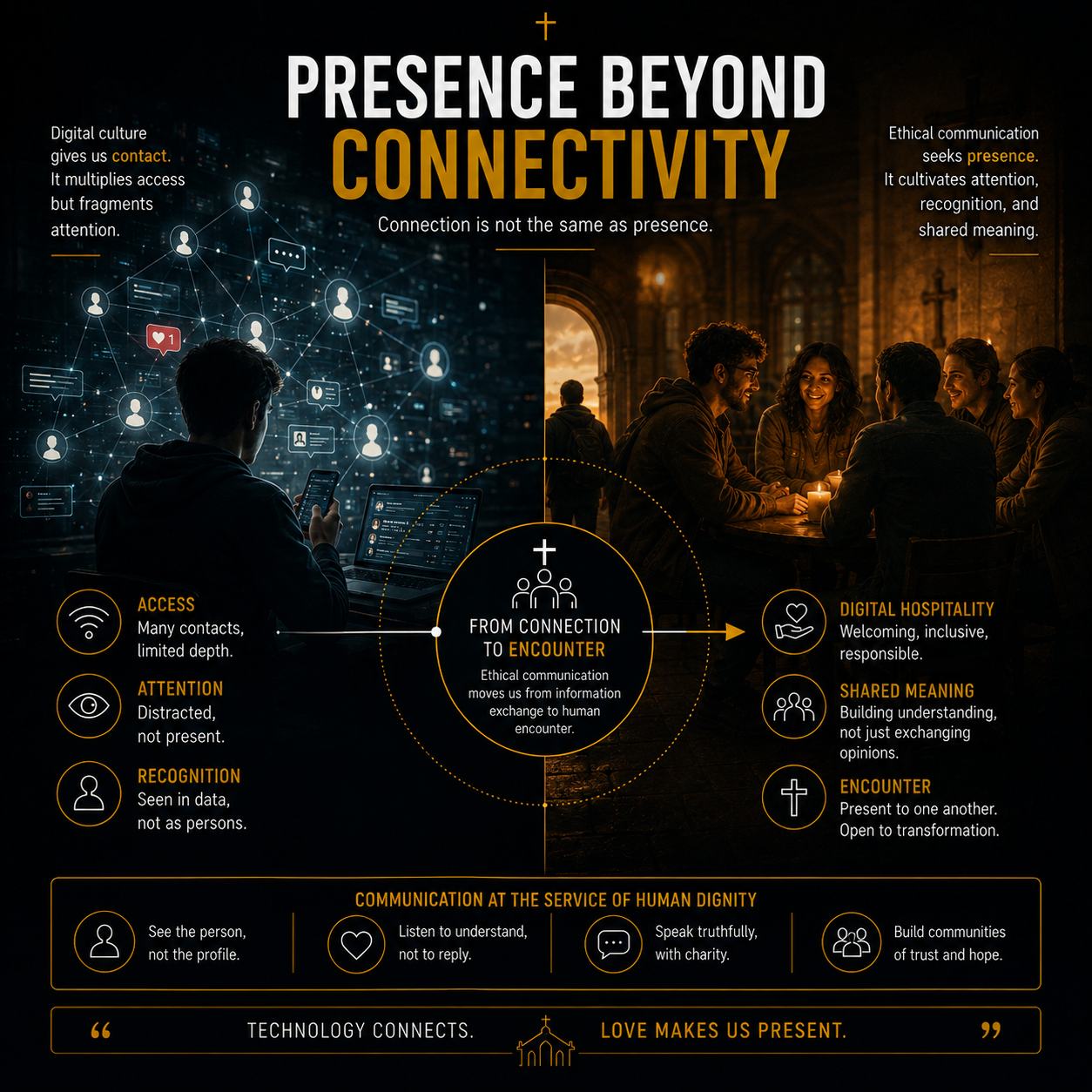
Digital culture gives us more contact than ever, but contact is not the same as presence. The task of ethical and ecclesial communication is to recover the depth of encounter within environments of permanent connection.
Digital culture has multiplied the possibilities of contact.
We can write, react, publish, share, respond, forward, stream, and appear almost everywhere at once. Institutions can speak across continents. Communities can gather without sharing the same physical place. Ecclesial communication can reach people who may never enter a parish hall, attend a diocesan meeting, or open an official document.
This is not insignificant.
Connectivity has real value. It can make visible what was once hidden. It can give voice to people at the margins. It can sustain relationships across distance. It can help institutions communicate with greater speed and wider reach.
But connectivity also creates a temptation: to confuse access with encounter.
A person can be reachable and still be absent. A community can be active online and still lack communion. A Church institution can produce content every day and still fail to communicate presence. The deeper question is therefore not simply whether we are connected. The question is what kind of presence our communication makes possible.
Digital environments often reward speed, frequency, and visibility. They encourage reaction before reflection, exposure before depth, and immediacy before discernment. In such environments, communication can easily become a sequence of signals rather than a place of relation. This affects not only personal relationships, but also institutional and ecclesial communication.
A parish social media page, a diocesan website, or a Vatican media platform may distribute information efficiently. Yet ecclesial communication is never only distribution. It carries a theological and relational responsibility. It should not only announce events, repeat messages, or manage visibility. It should help create conditions for recognition, listening, and shared meaning.
This is where the distinction between connection and presence becomes decisive.
Connection can be technical.
Presence must be relational.
Connection depends on access.
Presence depends on attention.
Connection can be measured by reach.
Presence is measured by the quality of encounter it makes possible.
For ecclesial communication, this distinction is especially important because the Church does not communicate only as an institution among institutions. It communicates as a community called to witness communion. That means its digital presence cannot be evaluated only through metrics: followers, views, clicks, impressions, or engagement rates.
These indicators may be useful, but they are not enough.
A message can reach thousands and still fail to touch the deeper level of meaning. A post can generate reactions and still not generate understanding. A platform can amplify visibility and still produce distance.
The challenge is to inhabit digital culture without being absorbed by its reduction of communication to performance.
- This requires a different communicative discipline.
- It requires slowing down the logic of speed.
- It requires resisting the idea that every silence is a failure.
- It requires creating spaces where communication is not merely consumed, but received.
- It requires a form of digital hospitality.
Digital hospitality means that online communication is not imagined only as broadcasting, promotion, or institutional self-presentation. It becomes a way of making room: for questions, for listening, for recognition, for encounter.
This does not mean abandoning strategy. It means placing strategy inside a deeper anthropology.
The human person is not a user to be captured, a target to be reached, or a profile to be analyzed. The human person is someone capable of meaning, relation, attention, and response. When communication forgets this, it may remain efficient, but it becomes thinner.
Vox Communicandi begins from the opposite assumption: communication is not simply transmission. It is formation. It forms how people interpret reality, how institutions are trusted or distrusted, how communities imagine themselves, and how relationships are sustained.
- In this sense, the crisis of digital communication is not only technological.
- It is relational.
- We do not lack channels. We lack depth.
- We do not lack signals. We lack presence.
- We do not lack content. We lack encounter.
The task is therefore not to reject digital culture, but to communicate within it more responsibly. The point is not to idealize the offline world or demonize the online one. The point is to ask whether our digital practices still serve human and ecclesial goods.
- Do they deepen attention?
- Do they sustain trust?
- Do they foster communion?
- Do they make room for the other?
If not, then our communication may be connected, but not truly present.
And perhaps this is one of the central tasks of ethical communication today: to recover presence in a culture that has confused being reachable with being together.