
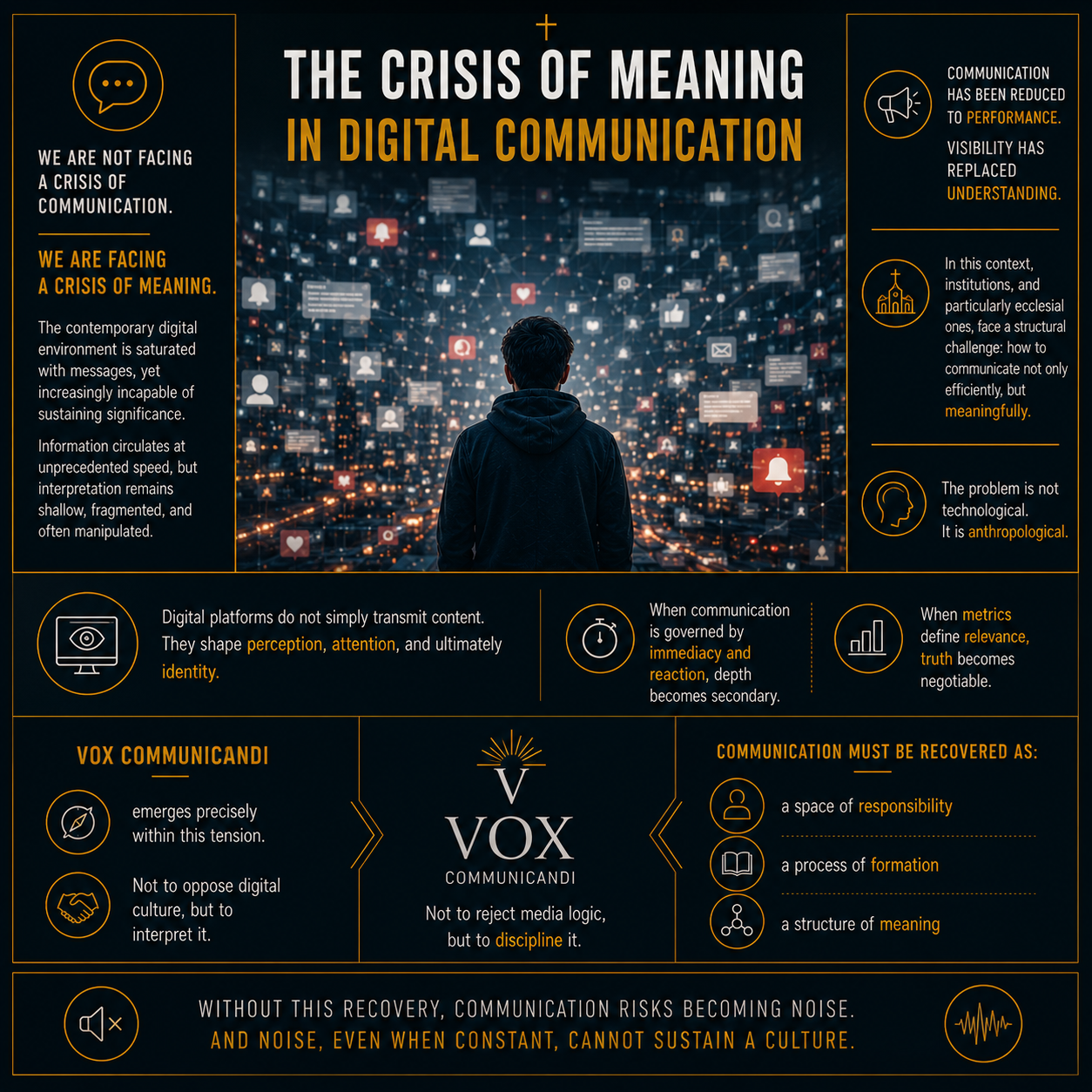
We are not facing a crisis of communication.
We are facing a crisis of meaning.
The contemporary digital environment is saturated with messages, yet increasingly incapable of sustaining significance. Information circulates at unprecedented speed, but interpretation remains shallow, fragmented, and often manipulated.
Communication has been reduced to performance.
Visibility has replaced understanding.
In this context, institutions, and particularly ecclesial ones, face a structural challenge: how to communicate not only efficiently, but meaningfully.
The problem is not technological. It is anthropological.
Digital platforms do not simply transmit content. They shape perception, attention, and ultimately identity. When communication is governed by immediacy and reaction, depth becomes secondary. When metrics define relevance, truth becomes negotiable.
Vox Communicandi emerges precisely within this tension.
Not to oppose digital culture, but to interpret it.
Not to reject media logic, but to discipline it.
Communication must be recovered as:
– a space of responsibility
– a process of formation
– a structure of meaning
Without this recovery, communication risks becoming noise.
And noise, even when constant, cannot sustain a culture.